The Hospital Where My Dad Was Born — and the Remarkable History I Didn’t Expect to Find
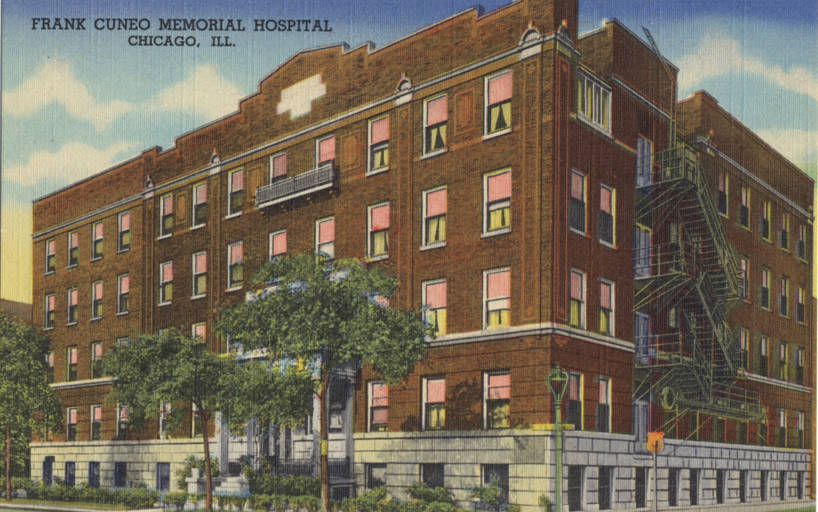
Of all the old family photos and odds and ends I’ve scanned and saved over the years, this is the one that sent me down the deepest rabbit hole. It’s a vintage postcard of the Frank Cuneo Memorial Hospital in Chicago — the hospital where my dad was born. I went looking for just a little background on the place, and what I found turned out to be a much bigger and more interesting story than I ever expected: a tale of a widower’s grief, a saint, a famous printing fortune, a mid-century architectural gem, and, in the end, the wrecking ball. So I figured I’d write it all down in one place. Here’s what I dug up about the hospital my dad came into the world in.

A produce magnate named Frank Cuneo
The hospital took its name from Frank Cuneo, a man whose name was once very well known in Chicago even if most people have forgotten it today. Born in 1861, Frank came up through an Italian immigrant family and made his fortune in, of all things, produce. He was president of Garibaldi & Cuneo, a big wholesale fruit and vegetable house, and he reinvested those profits shrewdly into Chicago real estate. He was one of the businessmen who helped build up the bustling Wilson Avenue district in the Uptown neighborhood on the city’s North Side during its booming 1920s heyday. By any measure, he was a wealthy and successful man.
But behind the business success was a private heartbreak that, in a roundabout way, is the reason the hospital exists at all. Back in 1891, decades before any of his philanthropy, Frank’s young first wife, Amelia, died in childbirth. It’s the kind of loss that never really leaves a person. Years later, when he finally had both the means and the motivation to do something lasting in her memory, he didn’t put his name on a concert hall or a library. He put it behind a hospital for women and children — so that other families might be spared the very grief that had visited his own. When you know that, the whole place reads a little differently.
The Sisters — and a connection to America’s first saint
By the late 1930s there was a struggling hospital on Clarendon Avenue in Uptown called Lake View Hospital, with roots going back to around the turn of the twentieth century. Like a lot of institutions in that era, it had fallen on hard financial times, and in 1939 it was taken over by a Catholic order of nuns: the Missionary Sisters of the Sacred Heart of Jesus.
It helps to picture the neighborhood. Uptown in those years was one of Chicago’s liveliest, fastest-growing parts of town, and a genuine destination — jazz clubs and grand movie palaces, the busy Wilson Avenue shopping district that Frank Cuneo himself had helped build, and apartment buildings going up about as fast as crews could raise them. A booming neighborhood needs a hospital, and Lake View filled that role until the lean years of the Depression finally caught up with it. By the time the Sisters stepped in, the institution was shuffling and expanding across the avenue, and the older original building had even been pressed into service as a residence for the hospital’s nurses.
The Missionary Sisters are worth pausing on, because it’s a genuinely remarkable connection. The order was founded by Mother Frances Xavier Cabrini — St. Frances Cabrini — the tiny, tireless Italian-born nun who crisscrossed the country founding hospitals, schools, and orphanages for immigrants. In 1946 she became the first American citizen ever to be canonized a saint.
She had already established Columbus Hospital in Chicago, so her Sisters were no strangers to running a hospital. In other words, the hospital my dad was born in was operated by the religious order of the first American saint. That is not a bad little footnote to find hiding in your own family history.
This is where Frank Cuneo re-enters the picture. He stepped in to help the Sisters keep the struggling hospital afloat, and in gratitude it was renamed in his honor — specifically as a charity maternity hospital dedicated to the memory of Amelia. True to his character, he attached a few conditions to his generosity. He insisted that a portion of the beds (one account puts it at twenty percent) always be reserved for charity cases, for women and children who couldn’t pay, and that the place be known at all times simply as the Frank Cuneo Hospital. A newly rebuilt Cuneo hospital opened in July of 1942 — and that 1942 building is the one you see on the vintage postcard above.
A mid-century landmark rises
The story doesn’t end with Frank, who died in 1942, the same year the rebuilt hospital opened. His son picked up the torch and carried it even further. John F. Cuneo Sr. was a Chicago legend in his own right — the man behind the Cuneo Press, which grew into one of the largest printing companies in the entire country, and later chairman of the National Tea Company grocery chain. John and his wife, Julia, became the hospital’s great benefactors and fundraisers, pouring the family’s printing-and-grocery fortune into keeping the Sisters’ work going.
All of that money and momentum led to something special. In 1957, a brand-new Frank Cuneo Memorial Hospital opened its doors — a thoroughly modern, 140-bed women and children’s hospital that was considered one of the most up-to-date facilities of its kind anywhere. It was designed by the architect Edo J. Belli, who was busy bringing a fresh, clean modernism to Catholic architecture all over Chicago. The new Cuneo was full of striking touches: a distinctive roofline said to resemble an artist’s palette, operating rooms and corridors finished in individually designed Romany-Spartan glazed tile, and a chapel decorated with murals by the Chicago artist John A. Mallin. When it was dedicated in 1957, the ceremony was led by Cardinal Samuel Stritch, with none other than Mayor Richard J. Daley in attendance. For a neighborhood hospital, that is a serious guest list.

From hospital, to shelter, to empty lot
For three more decades the Missionary Sisters ran the new hospital, delivering babies and caring for families on the North Side, until they finally closed it in July of 1988. After that, the building took on a second life as the Columbus-Maryville children’s shelter, a place of refuge for kids who needed somewhere safe to stay. That chapter didn’t last forever either, and by around 2005 the once-gleaming modern hospital sat dark and empty.
From there the story follows a sadly familiar path for grand old buildings. Preservationists recognized the architectural value of Belli’s design and tried to make the case for saving it, but an empty building with no clear use is a hard thing to rescue. In the end the case was lost, and on January 20, 2017, the demolition crews moved in. The mid-century landmark that had stood on Clarendon Avenue for sixty years came down, and the site was cleared for whatever would come next.
A century of births, prayers, and recoveries reduced, in a matter of weeks, to a vacant lot.
Why I bothered to chase all this down
I’ll be honest: I started out just wanting a caption for an old postcard, and instead I lost an evening reading about Italian produce barons, a globe-trotting saint, a printing dynasty, and a beautiful building I’ll now never get to walk through. But I’m glad I did. There’s something about tracing the history of a single corner of a city — watching it get built, renamed, rebuilt, repurposed, and finally torn down — that puts your own little place in the timeline into perspective.
The same patch of ground carried the same name and the same purpose across three different buildings and the better part of a hundred years, and somewhere in the middle of all of it, my dad was born.
That’s the thing about these places. Long after the bricks are gone, the memories and the records and a few lucky surviving photographs are what’s left to tell the story. I can’t visit the Frank Cuneo Memorial Hospital anymore — nobody can — but at least now, thanks to a scanned postcard and a few patient local historians, its story is written down in one more spot on the internet. If you have an old family photo gathering dust somewhere, take it from me: scan it, and go find out what it was. You never know what you’ll turn up.
Sources & further reading
Much of the local detail here comes from the wonderful Lakeview Historical Chronicles: Hospitals Past & Present, with additional history from Preservation Chicago and ChicagoAncestors.org.
Postcard photo credit:
https://4.bp.blogspot.com/-K0-zJP1bp44/VmETlBMEKaI/AAAAAAAAKzc/o2HF2Cbit9o/s1600/Frank_Cuneo_Memorial_Hospital_1948.jpg


