
The “Fad” That Never Faded: Why AI in 2026 is 1996 All Over Again
The short version: Back in the ’90s I ran a dial-up ISP while half the people I knew were sure the internet was a passing fad. AI in 2026 feels exactly the same to me, written off as a toy right as it quietly turns into something nobody will be able to work without. Here’s why I think that, what it can already do in plain terms, and how to start using it yourself.
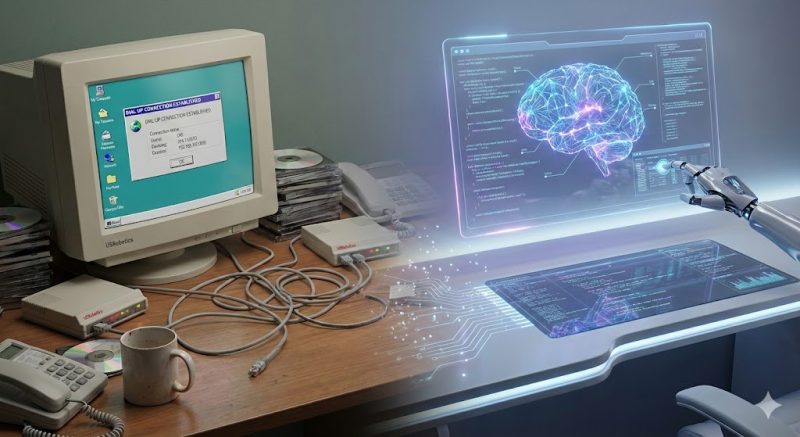
Back in 1996–1997, as I was finishing high school, I was knee-deep in modems, server racks, and long-winded conversations with people who had no idea what a “dial-up ISP” even was. I was trying to build something real, and just about everyone around me thought I was chasing a gimmick. The internet, according to the mainstream, was a passing fad. A nerdy hobby. Something that would burn bright for a year or two and then quietly disappear while normal life carried on.
My life trajectory changed from my ISP days because of Lyme disease, but the technology marched on and I’ve followed the tech and AI world ever since. (If you want a taste of what that local scene actually looked like, I once wrote about Menasha’s PowerNet, the old-fashioned corner store of the early internet.)
The internet obviously became much more than a passing fad.
And I’m watching the exact same movie play out right now with artificial intelligence.
People catch a glimpse of a chatbot, or see a goofy AI-generated image floating around social media, and they write the whole thing off. They think they’re looking at a novelty. A toy. A parlor trick that’s fun to mess around with but isn’t going to change anything real.
I get it. That’s exactly what people said about the internet in the mid-90s. And those people were wrong then. They’re wrong now, too.
As someone who had a front-row seat to the first digital revolution, I’ll tell you plainly: this isn’t a trend, and it isn’t a phase. It’s a ground-level shift in how we’re all going to live and work going forward, and it’s happening fast.
The only thing holding it back is the leash
Here’s the part most people don’t understand. A lot of the limitations you’re seeing with AI right now aren’t really technical: they’re financial and resource-based. What you’re tapping on your phone or laptop is the watered-down, consumer-friendly, “lite” version of this technology. You’re seeing it with the training wheels still on.
When you have the budget and the infrastructure to take the leash off and really let these systems run, the results get genuinely impressive. What I’m seeing in early 2026 from properly configured, fully resourced setups is well beyond what most people picture when they think “AI.” A few honest examples of where things stand:
Coding is being rewritten, literally. Modern models can already handle big chunks of programming on their own. I don’t think we’re far from a world where most standard, everyday programming is done largely by these systems, with people steering rather than typing every line. That’s not science fiction; it’s the direction things are clearly moving. Just last week I had AI write a working Windows program and a web-based tool for me, the kind of thing that used to mean weeks of effort.
Research that used to take days takes minutes. You can sit down today and have an AI system dig into a complex topic, draft a long report, or rough out a detailed business plan in the time it takes to get a coffee. The output still needs a human to check and refine it, that part matters, but the heavy lifting is already handled.
The gap is bigger than people realize. There’s a real disconnect between what the average person thinks AI can do and what it’s actually capable of in well-funded labs and private firms. That gap between public perception and real capability is wider right now than it’s ever been, and that’s the part that sticks with me. Not because I’m scared of the technology, but because most people have no idea how quickly the ground is moving, and they aren’t preparing for it at all.
But what does this actually do for you?
I know most of you don’t care about the technical side of the things you use every day. The systems that make your game console work, the app on your phone, the remote for your TV, the brains inside your appliances: every one of those was traditionally built on millions of hours of human programming. And as these systems get more advanced, they get more complex and harder to program. Just like there are dozens of human languages spoken around the world, there are dozens of programming languages too, and it’s genuinely hard to get them all working together across different devices, and harder still to find programmers who truly understand all of them.
This is where AI is starting to act like a master key. It’s letting all the pieces of this ever-expanding, increasingly complicated world talk to each other more easily and with more fluidity, and it’s letting programmers work far faster across a much wider variety of environments. The practical payoff: more programs, more features, faster, and ideally cheaper than ever before.
And that turns into real-world benefits you’ll actually feel. Systems that simply work better. Call-center setups that can quickly find your relevant information and fix your problem instead of bouncing you around for an hour. I’m not saying every company is going to flip a switch and do this tomorrow (they won’t), but the capacity is there now. We’re also going to see big gains in medicine, where AI systems can spot problems a doctor simply doesn’t have the time, the breadth of knowledge, or the hours to catch. We’ve already seen AI tools flag rare diseases that had been missed, the kind of needle-in-a-haystack diagnosis that would have been nearly impossible just a few years ago.
This isn’t really a choice
I’m not here to debate the ethics of massive data centers, or argue about what AI is going to do to the job market, or get into the water and energy these systems consume. Those are real conversations and they matter. But here’s the hard truth: none of them are going to stop this train.
This technology is moving forward because it’s simply too powerful and too efficient to ignore. The economics are too compelling and the competitive advantages are too big. No government, no industry, and no social movement is going to put this genie back in the bottle. It’s out, and it’s not going back in.
Think about the 90s for a second. Back then you could choose not to have an email address. You could hold out and insist it was unnecessary. But eventually the world moved on without you: job applications went online, communication went digital, and one day you woke up and realized you had no choice but to catch up or get left behind.
AI is following the same playbook. The only real difference is the speed: what took the internet a decade, I think AI compresses into a year or two.
Where I think this goes (and what I’m not sure about)
So where does this actually head? Let me be honest about which part I’m sure of and which part I’m not. In the next year or two, I think we’ll see these highly optimized AI tools get woven into the bigger systems we all deal with: more efficient customer service, smoother medical offices, that sort of thing. The technology to do it is basically here already. The part I genuinely don’t know is how long it’ll take businesses to truly adopt it. That’s the piece I’m waiting to see.
But the direction looks clear to me: huge improvements in access to information, in problem-solving, and in science, engineering, and medicine, with the real potential for exponential growth rather than the slow, steady kind. Advances in materials science that lead, in turn, to advances in how we physically produce goods, deliver services, and build things. I think we’re on the verge of AI being able to see solutions to problems humans haven’t cracked yet, or would only crack over decades, and finding them in days, weeks, or even hours instead.
That’s a prediction, not a promise, and I’m putting a date on it on purpose: it’s February 2026 as I write this. We’ll see how it holds up.
Where to start
If this has you even a little curious, here’s what I’d actually tell you to do.
Pay for a real account. Spend the $20 a month on one of the big players (ChatGPT, Gemini, or Claude) and actually use it for a month. The free tiers are the watered-down version I mentioned earlier; the paid models are a different experience. Pick one, play around, and get a feel for how the different models behave.
Then ask it something real, something well beyond what you’d normally type into Google. And here’s the key: talk to it like a person. Don’t just bark “zucchini bread, no butter, half size.” Give it the whole picture: “I’m looking to adapt my usual zucchini bread recipe. Here’s a photo of the one I normally use. I need it dairy-free, and I want to bake it in a loaf pan that’s half the normal size. What would be a logical way to adjust it?” Then let it do the work. The more context you give it, the better it gets.
A real example from my own life: my dad has a 1998 BMW, and a couple of things went wrong with it. I described the symptoms in detail to Gemini Pro, and it worked out the exact problems, the exact parts to replace, where to look, which panels had to come off, and what to order. Could we have pieced that together from five hours of forum-diving? Sure. It did it in a couple of minutes.
That’s the whole shift in a nutshell: the kind of real-world research that used to eat an entire afternoon now takes a minute or two. Start putting that to work in your actual life (recipes, repairs, planning, whatever you’ve got) and you’ll feel the difference fast.
The bottom line
Whether you’re excited about it, nervous about it, or flat-out against it, AI is going to reshape our lives in real and largely unavoidable ways. The technology is already more capable than most people have any clue about, and it’s improving at a pace that’s hard to wrap your head around even when you’re paying close attention.
I watched the skeptics be dead wrong about the internet in 1996. I think they’re wrong again in 2026, only this time the “fad” is going to rewrite a lot of daily life before most people even notice the dial-up tone stopped ringing. If you haven’t started taking AI seriously yet, my honest advice is to start now. Not next month, not next year, now.
I’d genuinely like to hear where you land on this, whether you think I’m right or think I’ve lost the plot. Drop a comment and tell me.
Note: I wrote the base of this article myself, then edited and polished it with the help of about ten cents’ worth of AI. Fitting, given the subject.


