Historic Paine Mansion Meets Modern Art: Experiencing the Nature of Light at the Paine | Oshkosh, WI
Every fall the Paine Art Center and Gardens in Oshkosh turns its historic mansion into something genuinely magical with their Nature of Light show, and in 2022 we finally went to see it for ourselves. We’d driven past the Paine plenty of times and always meant to stop in, but there’s something about the idea of wandering a century-old Tudor estate after dark—lit from the inside out—that finally got us in the car. It did not disappoint.
If you’ve never heard of it, The Nature of Light debuted in 2022 as a one-of-a-kind, after-dark experience built specifically for the Paine. It’s a collaboration between the museum, the artist duo known as HYBYCOZO, and the international lighting design firm Lightswitch, and the scale is hard to overstate—more than a thousand individual lights and over fifty illuminated sculptures spread across the grounds and through the mansion, each one programmed to wash the historic estate in shifting color. What makes it special is that it was never designed to travel. This version exists only here, tailored to the architecture, the woodwork, and the gardens of this particular place.
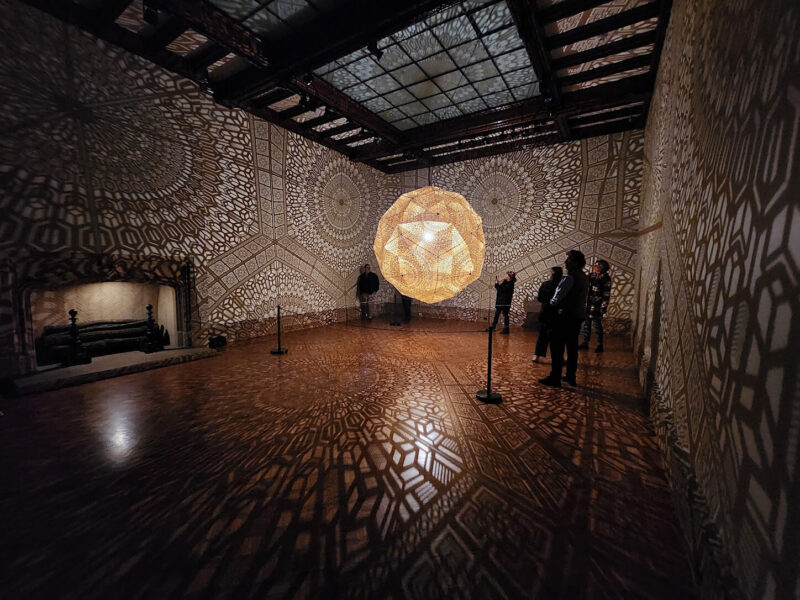
The first thing that hits you is how the darkness completely changes a building you might think you already know. During the day the Paine is all rich paneling, leaded glass, and oil paintings in gilt frames. At night, with the house lights off and the projections switched on, those same rooms become a canvas. Geometry crawls across the ceilings, pools of color drift over the floors, and the carved details you’d normally walk right past suddenly get picked out in light and shadow. It’s the kind of show that makes you stop mid-step and just take it all in.
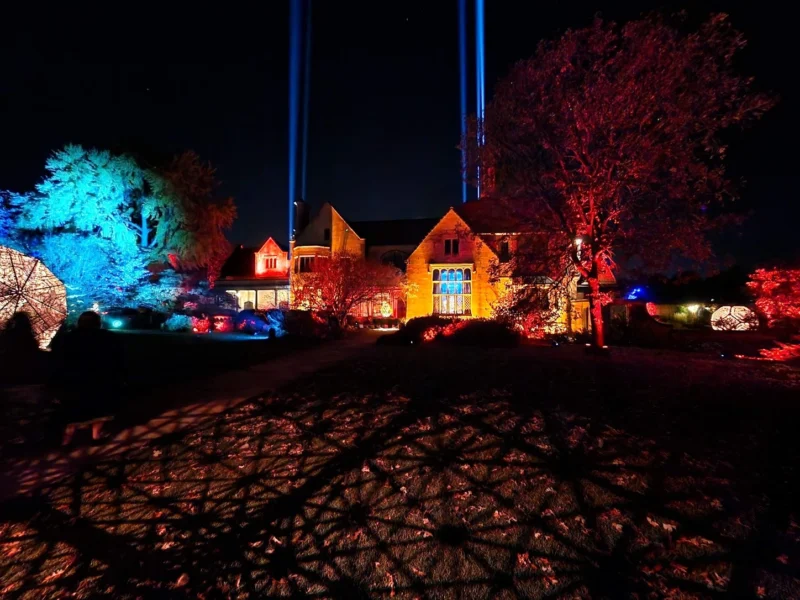
The exhibition is structured so you can choose how deep you want to go. The main experience takes you through the outdoor display, where more than a dozen illuminated settings fill the gardens with glowing sculptures, color, and beams of light that guide your eye from one vista to the next. There’s even live entertainment—costumed “light dancers” perform circus-style routines out in the gardens after sunset, which turns an already dreamy walk into something closer to a piece of theater. If you upgrade, you also get access to a series of rooms inside the mansion itself, complete with interactive installations you can actually touch and play with. That indoor portion is the most limited, simply because only so many people can move through the historic house at once.
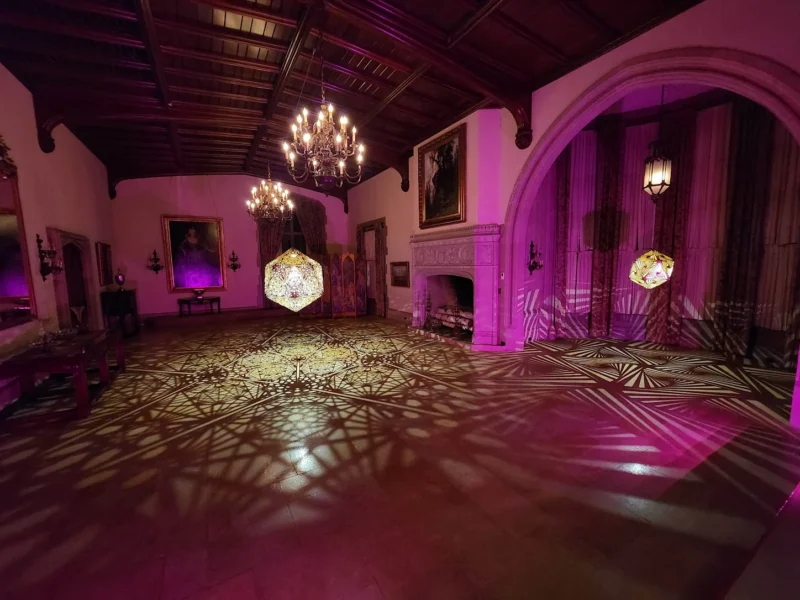
What I appreciated is that the show isn’t loud or gimmicky. It’s paced almost like a meditation—you wander, you slow down, you notice. The lighting is used to draw your attention through the space rather than overwhelm it, and the whole thing feels designed to make you contemplative rather than dazzled. There’s something here for everyone, too; little kids get to interact with the art in a way that’s the opposite of the usual “don’t touch” museum experience, while adults tend to drift around quietly, phones out, trying (and mostly failing) to capture how it actually feels in person.
The Artists Behind the Glow: HYBYCOZO
The sculptural heart of the show comes from HYBYCOZO, the studio of artists Yelena Filipchuk and Serge Beaulieu. Their story is honestly one of my favorite parts of the whole thing. The two met in the San Francisco Bay Area back in 2008, both longtime attendees of the Burning Man arts festival, and they bonded over a shared fascination with the place where science and art overlap—the patterns that show up in nature, the structure underneath physics, the idea that math has a kind of resonance the eye and heart respond to. In 2014 they built their first collaborative installation out on the desert playa: three steel polyhedrons that looked solid and sculptural by day, then transformed after sunset into glowing forms casting otherworldly patterns of light and shadow across the sand.
That first piece gave the studio its name. HYBYCOZO stands for “Hyperspace Bypass Construction Zone,” a nod to Douglas Adams’s The Hitchhiker’s Guide to the Galaxy, which happens to be both artists’ favorite book—and yes, several of their later works are named after things from that novel, too. The work caught fire (figuratively) after the 2016 Burning Man festival, when images of the sculptures went viral, and from there the duo’s career took off in a way few public artists ever experience.
The pair bring very different backgrounds to the table, and you can feel both of them in the finished work. Yelena, born in 1987 in Lviv, Ukraine, studied Conservation and Resource Studies at UC Berkeley, focusing on patterns in the natural world, biomimicry, and environmental justice before moving into studio art and digital fabrication. Serge, born in 1981 in Revelstoke, British Columbia, trained as an industrial designer and spent about a decade in design studios before walking away from that career to make large-scale art full time. His technical, manufacturing-minded sensibility and her science-and-ecology lens combine into something neither could make alone.
Their signature technique is laser-cutting intricate patterns into massive geometric forms—platonic solids, Archimedean shapes, stellated icosahedrons, the kind of polyhedra most of us last thought about in a high school math class. The magic is in the transformation. By daylight the sculptures read as solid, bold, almost monumental objects. After dark, light pours out through the cutouts and the solid forms seem to dissolve, throwing delicate filigree shadows in every direction and turning the space around them into part of the artwork. It’s a deceptively simple idea—form, light, shadow—executed with obsessive precision, and it’s exactly why their pieces work so beautifully inside an ornate old mansion.
This isn’t fringe festival art anymore, either. HYBYCOZO has shown with the Smithsonian’s Renwick Gallery as part of its landmark Burning Man exhibition, and they have permanent public sculptures installed everywhere from Dubai and Istanbul to Las Vegas, Sacramento, New Zealand, and back home in the Bay Area. Knowing all of that, it feels like a genuine coup that Oshkosh got an exclusive, full-property installation from them.
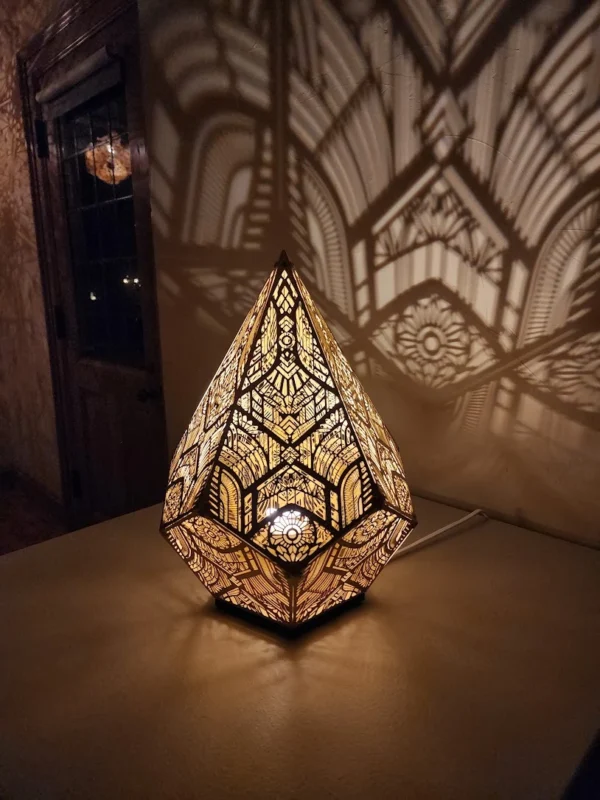
If HYBYCOZO supplied the sculptures, the firm Lightswitch supplied the atmosphere. Founded by lighting designer John Featherstone, Lightswitch has spent more than thirty years lighting everything from concert tours for artists like Hans Zimmer, Michael Bubé, and Halsey, to theme-park work for Disney and Universal, to genuinely jaw-dropping one-offs like relighting the Great Pyramids of Giza. For the Paine, the firm spent months studying what the estate means to Oshkosh and how to use light to lead visitors gently through the architecture and the gardens without ever fighting the building’s character. The two studios had collaborated on smaller pieces for nearly a decade, but The Nature of Light was their first full, large-scale exhibition together—and the partnership shows.
The House Itself: A Mansion the Owners Never Lived In
Half the reason the show lands the way it does is the setting, and the Paine has a fascinating, slightly melancholy history of its own. The estate was built for lumber baron Nathan Paine and his wife, Jessie Kimberly Paine. Nathan ran the thriving Paine Lumber Company, which sprawled across 60 acres along the Fox River and employed more than 2,000 workers, while Jessie was the daughter of a co-founder of Kimberly-Clark, the paper giant just up the road in Neenah. This was old Wisconsin industrial money, and they set out to build something to match it.
In the mid-1920s the Paines commissioned Bryant Fleming, an architect and landscape designer from Ithaca, New York, to create an English-inspired Tudor Revival estate—one deliberately designed to feel as though it had grown and weathered over three centuries. Construction began in 1927, and the exterior was finished by 1930. Nathan, who had watched fire repeatedly devastate Oshkosh in the 1800s and had even lost one of his own homes to a blaze, insisted the mansion be fireproof, so it was built of steel, cement, and limestone. Then the Great Depression arrived, hammered the Paine Lumber Company, and by 1932 all remaining work on the house simply stopped.
Here’s the part that always gets me: the Paines never actually lived in the mansion. Nathan died in 1947, and rather than turn it into a private residence, the couple’s long-held plan to open the estate to the public as a museum moved forward, with the Paine welcoming visitors beginning in 1948. Jessie went on to serve as the museum’s president from afar—she lived in La Jolla, California—until her death in 1973 at the remarkable age of 100. The property is listed on the National Register of Historic Places, and the grounds have grown into roughly four acres of garden “rooms,” around twenty distinct designed spaces filled with thousands of plant species. Inside, the house holds a collection heavy on French Barbizon and American landscape paintings, plus sculpture, tapestries, Persian rugs, and fine silver and china.
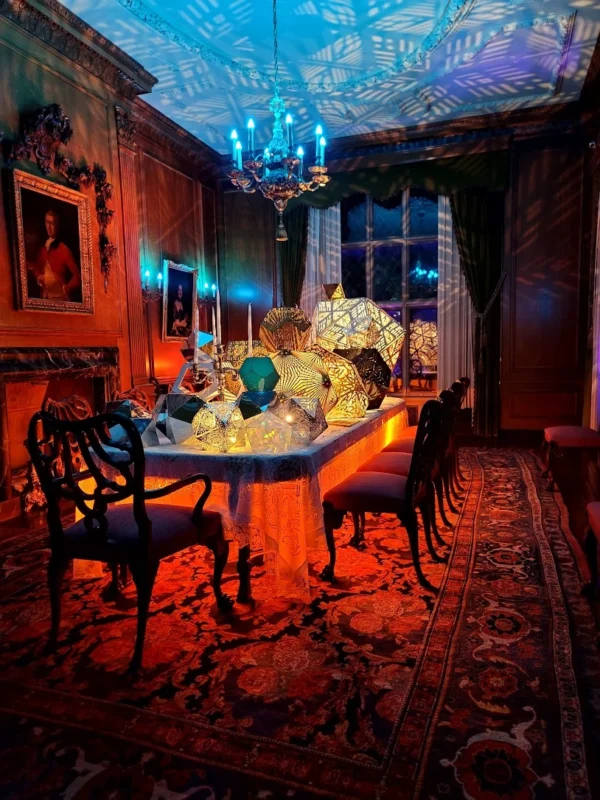
So when you walk through during The Nature of Light, you’re moving through a kind of beautiful contradiction—a grand 1920s home that was meant to feel centuries old, that its owners never slept a single night in, now reinterpreted by Burning Man artists with lasers and code. Intricate designs crawl across the walls, ceilings, and floors; a softly glowing orb anchors one room while the period furniture and rich woodwork are washed in shifting blues and golds; and beautiful stained-glass-style lamps throw lacework shadows in every direction. The old craftsmanship and the new technology end up speaking the same language, which is really the whole point.
A few practical notes if you’re thinking about going: this is a fall, after-dark event, so dress for a Wisconsin evening and wear comfortable shoes since you’ll be walking the gardens. Reservations for the indoor mansion rooms tend to sell out first, so book early if you want the full experience. Photography is welcome, though I’ll warn you now that no phone really captures how the shadows move—you kind of have to be there. And since the Paine has continued to bring the show back in the years since 2022, it’s worth checking their current dates before you plan your trip.
Bottom line: The Nature of Light turned out to be one of the most memorable evenings we’ve spent in the Fox Valley. It’s art, architecture, and history all stacked on top of each other in a place that already feels a little bit like stepping into another era. If it’s running when you’re in the area, go.
Paine Art Center and Gardens
1410 Algoma Blvd, Oshkosh, WI 54901
Nature of Light show – Fall 2022
(920) 235-6903
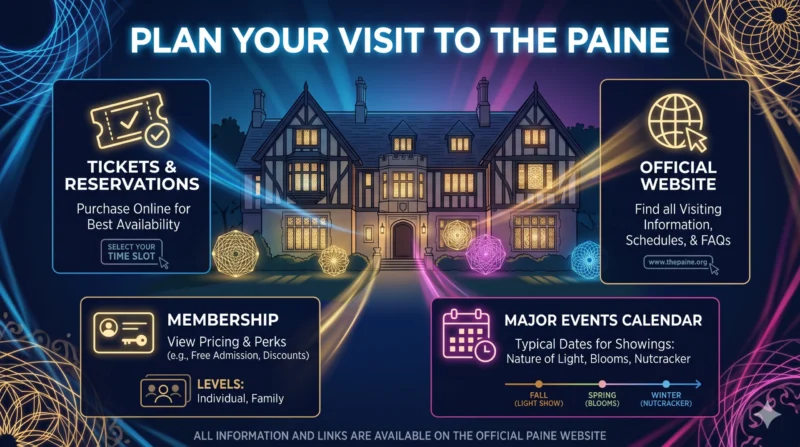
Plan Your Visit to the Paine Art Center
If you’re planning a trip to experience the Paine Art Center and Gardens for yourself, here is everything you need to know about admission, memberships, and typical event schedules.
Tickets & Admission Prices
General admission to the historic mansion and gardens typically runs $12 for adults and $7 for youth (ages 5-17). Special exhibitions like The Nature of Light or Rooms of Blooms usually have dedicated reservation tiers, with tickets for the main experience starting around $16 for adults and $12 for youth. Children 4 and under are always free. Advance online reservations are highly recommended for special events, as time slots frequently sell out.
Membership Prices & Benefits
If you plan to visit the estate more than once a year, a membership pays for itself quickly:
- Individual Membership: $75
- Family Membership: $100
Members receive free general admission year-round, 50% off special presentations (like The Nature of Light), early access to reservations, and a 10% discount in the gift shop and at the annual plant sale.
Discounts
The Paine frequently partners with local organizations to offer admission specials. For example, Community First Credit Union members often receive 2-for-1 admission during select preview weeks of major events. Additionally, you can occasionally find general admission experience passes available for checkout at local public libraries in the surrounding Fox Valley area.
Typical Dates for Major Events
While the gardens are stunning all summer, the estate completely transforms for three major annual events:
- Rooms of Blooms: Typically held over two weeks in early to mid-March, featuring incredible floral installations throughout the mansion.
- Summer/Fall Exhibitions (e.g., The Nature of Light): These immersive property-wide installations usually run from early August through late October.
- Nutcracker in the Castle: A beloved holiday tradition running from mid-November through early January, featuring elaborately decorated rooms and live performances.